Thursday, July 3, 2014

Tea Review: Bai Hao Oolong/Oriental Beauty (Teahouse Kuan Yin)

Bai Hao Oolong (Oriental Beauty)
Teahouse Kuan Yin
Type:  Oolong
Origin:  Not available
Product Description:  Not available.

Temperature: 185° F
Amount: 3 grams
Steeping Time: 3 minutes

The dry leaf aroma is floral and has notes that remind me of a fragrant wood similar to paulownia.

The golden infusion has a floral and honey aroma.  The taste is floral with a touch of honey and a long, floral finish.

This tends more flowery than other Oriental Beauty oolongs I've encountered.  A slightly lower steeping time brought out a bit more of the honey aroma and flavor, but the floral notes remain prevalent.  After several steepings, the flavor and aroma remained bold and delicious.

I purchased this oolong some time ago and it is not listed on their website at this time.


Monday, December 2, 2013

Tea Review: Avongrove Darjeeling 1st Flush (Teahouse Kuan Yin)

Advent Tea Calendar Day 2

Avongrove Darjeeling 1st Flush (2012)
Teahouse Kuan Yin
Type:  Black
Origin:  Avongrove Estate, Darjeeling, India
Product Description:  Not provided.

Temperature:  208° F
Amount:  3 grams
Steeping Time:  3 minutes

The dry leaves have a spicy aroma with notes of wood, fruit, and even pepper.

The light amber infusion has an aroma of flowers and honey with a floral taste and a velvet finish.

This tea was a bit more powerful in flavor than I was expecting for a 2012 Darjeeling and I would like to try it again at a slightly lower brewing temperature.  At three steepings this tea remained aromatic and flavorful.  I noticed notes of honey more in the second steeping than in the first and third.  

I purchased this tea from Teahouse Kuan Yin in early 2013, and it appears that they do not currently have it in stock.


Thursday, September 19, 2013

Tea Review: Hojicha Green Tea (Teahouse Kuan Yin)

Hojicha Green Tea
Teahouse Kuan Yin
Type:  Green
Origin:  Not Provided 
Product Description:  An infusion of our hojicha has a light, sometimes reddish brown appearance, and carries a toasty, slightly caramel-like flavor. Its low caffeine level makes it a great choice on a cool evening.

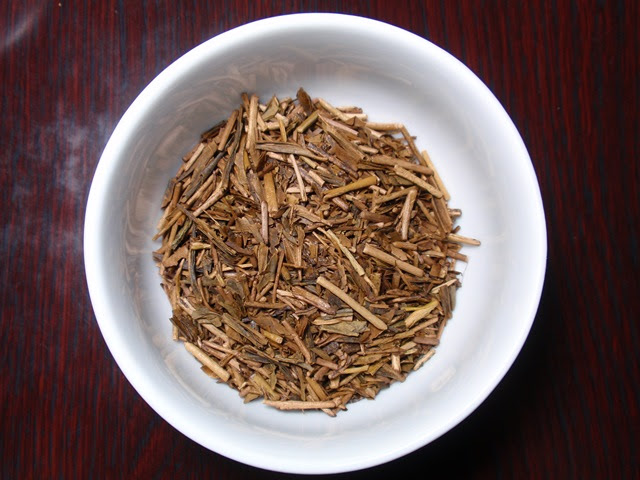
Hojicha is comprised of the stalks and twigs of bancha and kukicha teas, making it sweet and low in caffeine. It is charcoal roasted, making it unique among Japanese greens. This firing brings the color from green to a reddish-brown and gives it that toasty tone, while also making it longer lasting than other Japanese teas.


Temperature: 195° F
Amount: 3 grams
Steeping Time: 2 minutes

The dry leaves have a rich, smoky, roasted aroma with hints of spice (chili powder), burnt caramel, and fig.

The orange amber infusion has a rich, broth-like taste and aroma that reminds me of freshly roasted nuts and smoked wood.  

I was able to get two nice infusions from this hojicha without a notable loss of flavor, color, or aroma. While not traditionally a breakfast tea, I like it in the morning due to its dark, rich aroma and flavor as well as its low caffeine content.   I've found that it does quite well steeping up to 3 minutes in near-boiling water without becoming too astringent, though it doesn't have as much character on a second steeping.  At the slightly lower temperature of 195° F, the second infusion reminded me of a recent meal of chazuke (a Japanese dish made with rice, dashi, and green tea).

This tea was purchased by me.


Friday, July 5, 2013

Upcoming Event: Chocolate & Tea Tasting Workshop

Teahouse Kuan Yin and Chocolate Remedy will host a Chocolate & Tea Tasting workshop.

Chocolate & Tea Tasting
Sunday, July 14th
11:00am
$30  - Space is limited.

Saturday, April 20, 2013

Chocolate and Tea Tasting Workshop

Recently, I attended a Chocolate and Tea Tasting workshop at Teahouse Kuan Yin.  The event was hosted by Zyanya Breuer of Chocolate Remedy.


We were provided with samples of fine and origin chocolates paired with oolong, black, and pu-erh teas, skillfully prepared by Alice from Teahouse Kuan Yin.


Pairings:
  • Original Bean with Oriental Beauty
  • Bonnat with Gui Fei
  • Pralus with Keemun High Mountain 
  • Valrhona with Assam #8
  • Amedai with Black River Mountain Pu-erh
  • Domori (I believe we paired this with Oriental Beauty)

In addition to enjoying and comparing fantastic chocolates and teas, Zyanya shared a wealth of information from chocolate's historical origins as a currency and medicine to modern times where it is once again being recognized for its value and health benefits.

Like tea, chocolate can be enjoyed with all the senses and each chocolate experience is unique.  You can see and feel differences in texture and shine as well as stamping, specific to the manufacturer.  Break a piece and you should hear a sharp snapping sound.  Rub the chocolate's surface to bring out its aroma.  Then, let the chocolate melt on your tongue to savor its flavor and texture.

Following are are just a few of the interesting facts revealed in the workshop:
  • The quality of the chocolate is not always indicated by the percentage on the label.
  • Recent efforts have been made to protect origin chocolates, similar to recent efforts by the Tea Board of India to ensure authentication of origin for teas from Darjeeling.
  • Cocoa beans come in three types:
    • Criollo is the highest quality and represents only 1 percent of chocolate being produced today.
    • Forastero is a lower quality and is most widespread.
    • Trinitario is a blend (hybrid) of Criollo and Forastero
This workshop was a fun, delicious, and educational experience.  Keep an eye out for future tasting events from Zyanya and Chocolate Remedy!

Monday, March 25, 2013

Upcoming Event: Chocolate & Tea Tasting Workshop

Teahouse Kuan Yin and Chocolate Remedy will host a Chocolate & Tea Tasting workshop.

Sunday, March 31st or
Sunday, April 7th
11:00am
$30 - Space is limited to 10 participants at each class.

Thursday, March 14, 2013

Upcoming Event: The Art of Gong Fu Tea

As part of the Northwest Tea Festival's World of Tea Series, the Teahouse Kuan Yin will host The Art of Gong Fu Tea demonstration. 

The Art of Gong Fu Tea
Sunday, April 21st
11:00am - 12:30pm
$25 - Space is limited to 9 participants

Sunday, February 24, 2013

Tea Review: Ti Kuan Yin (Teahouse Kuan Yin)

Ti Kuan Yin
Teahouse Kuan Yin
Type:  Oolong
Origin:  China, Fujian Province
Product Description:  This classic example of a Ti Kuan Yin, one of the premier Chinese oolongs, is lightly vegetal and floral. Ti Kuan Yins are less oxidized and therefore more reminiscent of green teas, but without any astringency or grassiness.

Ti Kuan Yin, the tea from which Teahouse Kuan Yin takes its name, is itself named after Guan Yin, the Bodhisattva of Compassion. The name is often translated as Iron Goddess of Mercy, after an old translation of Guan Yin's name. Ti Kuan Yin is made in both Taiwan and China, and ours is the Chinese variety, made in Fujian province.


Temperature: 185° F
Amount: 3 grams
Steeping Time: 3 minutes

The dry leaf  has a deep and heady aroma, smelling of spicy plum.

The infusion is pale yellow with a full, floral aroma.  The taste is warm, floral, and a little sweet with an apricot finish.  I picked up something grain-like in the aroma after the second steeping.

This tea held up well through three steepings with almost no astringency.  The flavor notes and aroma were present throughout and I was left with a warm, clean taste long after the tea was gone.  This is certainly suitable to serve to guests who would enjoy the floral notes.

This tea was purchased by me.


Thursday, November 15, 2012

Tea Review: White Peony (Teahouse Kuan Yin)

White Peony Organic
Teahouse Kuan Yin
Type:  White
Origin:  China, Fujian Province
Product Description:  Our White Peony creates a gentle full-bodied brew, with scents of sweet straw, almond, and citrus. Its mouth-feel is smooth and velvety, and is prized for its low astringency and savory finish. It brews to a light shade of amber. Our current White Peony is IMO certified organic.
White Peony is a popular white tea consisting of buds and two leaves picked early in the spring. It is also referred to as Bai Mu Dan, and is grown in the northern region of the Fujian province. White Peony is darker than Silver Needle, but tends to be lighter than Shou Mei.


Temperature:  175° F
Amount:  2.5 grams
Steeping Time:  3 minutes

The dry leaf was sweet with a hay-like aroma.

The infusion was a bright, light amber with an aroma of spicy honey and hay.  The flavor was full-bodied and had a marine quality, with a savory-sweet characteristic similar to mirin and a velvety finish.

The flavor actually reminded me of the seasoning on inari sushi which is where I picked up the mirin quality.  I would feel comfortable serving this to my guests for at least three steepings as it holds up well throughout.  It was a surprise to find the flavor notes were unchanged while becoming milder with each steeping, yet the aroma became largely floral by the second infusion.

This tea was purchased by me.


Tuesday, November 13, 2012

Tea Review: Silver Needle Organic White Tea (Teahouse Kuan Yin)

Silver Needle Organic White Tea
Teahouse Kuan Yin
Type:  White
Origin:  China, Fujian Province
Product Description:  Silver Needle is the rarest and most prized of white teas. It is comprised of only the downy tea buds before they open, so that they resemble soft white needles. Its flavor is extremely fresh, because so little processing takes place in Silver Needle production. The leaves are very lightly oxidized, and undergo no frying or rolling process. Our Silver Needle is IMO-certified organic.

Temperature:  175° F
Amount:  2.5 grams
Steeping Time:  3 minutes

The dry leaf aroma was sweet and peppery with a hint of vinegar.

The infusion was bright, with a pale golden color and a delicate floral aroma.  The taste was sweet and flowery, with a velvety mouth feel and a surprising hint of something fruity like pear in the finish.

Though light, this tea was quite flavorful and held up well through a second steeping.  I would pair this with something lightly flavored like bread, brie, or pear slices.  I could happily drink this tea throughout the day and would definitely serve it to guests.

This tea was purchased by me.


Wednesday, October 10, 2012

Teahouse Kuan Yin

Teahouse Kuan Yin transitioned to online sales in June 2016.

Teahouse Kuan Yin has been a fixture in Seattle's Wallingford neighborhood since 1990.  It's located on 45th Street, just west of the Guild 45th Theatre, and conveniently close to the I-5.


Ask to see their tea menu and you'll be presented with a book filled with photos and details for all their many teas.  They also have pastries and sweets and get an Honorable Mention for their delicious gluten-free options.


In addition to their great selection of loose-leaf teas, Teahouse Kuan Yin offers teaware, supplies, and featured artist's works. 


While the Teahouse is a popular location and stays fairly busy, there is plenty of seating without feeling overcrowded.  If I had been visiting alone, I might have happily claimed one of those comfortable arm chairs for myself.


My tea and sweets were served on a Japanese lacquer tray.  After months of practicing ryakubon temae (tea ceremony using a lacquer tray), I had to fight a compulsive urge to artfully rearrange the tray's contents.  

My tea of choice was Long Jing (Dragonwell), a long-time favorite.  The name of the chocolate-dipped bar eludes me, so we'll just call it the Amaze-bar because it was amazingly decadent.  The gluten-free cinnamon scone was delightful and I'm looking forward to enjoying it again on future visits.  Moderation made a rare appearance and both sweets went home with me to be enjoyed over the remainder of the weekend.


Teahouse Kuan Yin is definitely worth a visit and a revisit and a... you get the idea.